Point, Shout, Go: The Hand Signals and Two-Word Cues Fueling FC Tokyo Park's U-10 Rosters

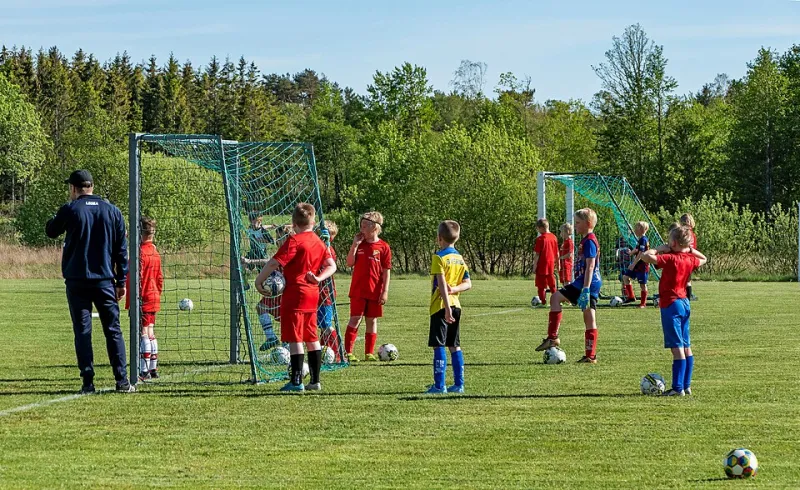
Photo by Photo by Alliance Football Club on Unsplash on Unsplash
Stand near the fence at a Saturday U-10 scrimmage at FC Tokyo Park and you'll hear something strange. Not Japanese, not English — something in between. A kid yells "Mizu! Mizu!" and his teammate spins her head without missing a step. Another flashes two fingers low at his hip and, somehow, everybody in a green jersey knows that means switch fields.
It looks like chaos. It's actually a system — one our coaching staff spent two seasons building, tweaking, and, most importantly, letting the kids themselves rewrite.
The Problem Nobody Saw Coming
When FC Tokyo Park started running mixed rosters — kids from Japanese-speaking households playing alongside kids from English-speaking ones — the assumption was that soccer is a universal language. And sure, to a degree it is. But anyone who's watched eight-year-olds play knows that eight-year-olds do not pass to a concept. They pass to a voice.
Head coach Dana Reyes noticed it first in small-sided drills. "The Japanese-speaking kids were calling for the ball in Japanese, the American kids weren't reacting, and then both groups decided the other side just wasn't passing," she says. "Nobody was being selfish. They were just missing each other."
That's the thing about a language gap at this age — kids don't experience it as a gap. They experience it as other kids ignoring them.
Building a Vocabulary of Eleven Words
Reyes and assistant coach Kenji Watanabe sat down that winter with a simple rule: whatever they created had to be learnable in a single practice session. If a new kid couldn't pick it up on day one, it was too complicated.
They landed on eleven cues. A handful of hand signals — a closed fist at chest height means "hold the ball," a flat palm pushed forward means "drive," two fingers swept across the body means "switch." A handful of two-word shouts, deliberately bilingual: "Tome! Stop!" became just "Tome-Stop," one hyphenated word the kids say at full sprint. "Kase! Press!" works the same way.
The English-Japanese pairing isn't accidental. Every cue exists in both languages, mashed together, so no kid is ever the one who has to translate mid-play. "We never wanted a situation where the Japanese-speaking kid has to do the extra work," Watanabe explains. "The system carries both languages equally. That was non-negotiable."
Then the Kids Took Over
Here's where the story gets good. Within a month, the players started inventing their own additions — and the coaches made the smartest decision of the whole project: they let them.
There's the elbow tap, which means "I'm behind you, don't turn" — invented, the kids swear, by a boy named Theo who was tired of getting stripped from behind. There's the two-syllable chirp of "Hai-hai" that the whole squad now uses as a running acknowledgment, somewhere between "got it" and "on my left." One signal — a quick point at their own cleats — apparently means "my shoes are untied, cover me." The coaches have officially adopted it.
"If a cue spreads on its own, that's the test," Reyes says. "We can teach anything. But when kids teach each other in the parking lot after practice? That's when it's real."
Why It Works When Everything Else Fails
Youth sports communication usually fails for a boring reason: the words are too long. "Switch!" requires a kid to process, decide, and respond. A fist at chest height requires nothing. Gestures travel faster than language at every level of soccer — ask any pro about scanning — and at the U-10 level, they sidestep the language question entirely.
The two-word shouts do something different. Because each one pairs both languages, they've quietly become the kids' first vocabulary lessons. Parents have started noticing.
"My son came home asking what 'hayaku' means," says Melissa Grant, whose family drives in from two towns over. "Then I found him teaching his little sister the hand signals at the dinner table. He doesn't think of it as learning Japanese. He thinks of it as learning soccer."
That's the pattern across the roster. Kids who've never set foot in a Japanese classroom are counting in Japanese during passing drills. Kids from Japanese-speaking households are bolder with their English, because on the field, the burden of translation belongs to the system, not to them.
What Other Clubs Can Steal From This
You don't need a bilingual roster to benefit — you need kids who aren't talking to each other yet, which is every U-10 team ever assembled. The FC Tokyo Park playbook, boiled down:
- Cap it at a dozen cues. More than that and the newest kid drowns.
- Pair every signal with a shout. Some kids are visual, some are auditory, all of them are loud.
- Let the players add to it. Ownership beats instruction every single time at this age.
- Make it symmetric. Whatever language mix your roster has, no kid should carry the translating load alone.
The U-10s won't remember the drills from this spring. But the fist-for-hold, the "Tome-Stop," the elbow tap — those might stick for years. And somewhere in there is the whole idea: the field isn't where kids wait until they speak the same language. It's where they build one.