Backyard Brilliance: 7 Training Drills Our Youth Coaches Actually Use (With Setup Tips for Parents)
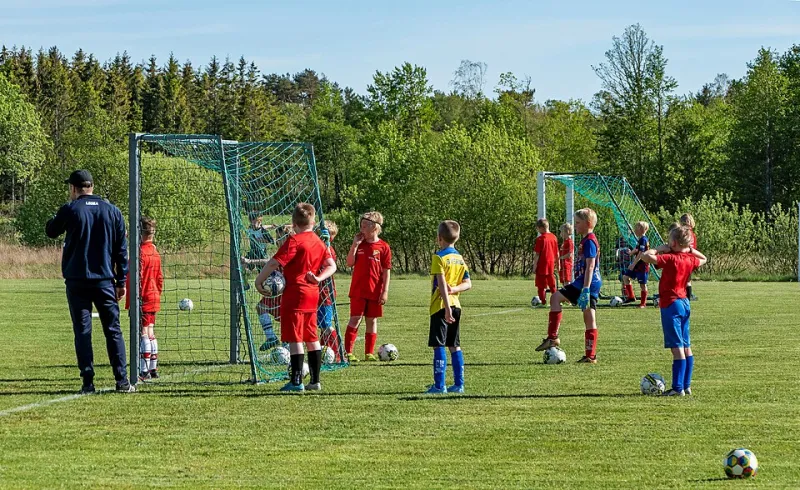
Photo: W.carter, CC0, via Wikimedia Commons
If you've ever watched an FC Tokyo Park academy session from the sideline, you've probably noticed something: a lot of cones, a lot of small-sided games, and very little standing around. That's not an accident. Our coaches borrow heavily from Japanese youth development, where technical precision and repetition are treated as building blocks, not chores.
The good news? You don't need a full pitch or expensive equipment to reinforce what your kid learns at practice. We asked our coaching staff to share the drills they rely on most — plus how parents can set them up at home.
1. The Rondo Circle
Setup: Four players (or three, or two plus a parent) form a circle around one defender. The circle passes the ball; the defender tries to win it.
Skill target: Quick decision-making, passing accuracy, first touch under pressure.
Parent tip: Keep the circle small — 5 to 8 yards across. If the defender isn't getting touches, shrink it. Ten passes equals a "win" for the circle; three steals means switch.
2. Cone Dribbling Gauntlet
Setup: Line up 6–8 cones in a straight row, roughly 2 feet apart. Player dribbles through with the outside, inside, and sole of each foot.
Skill target: Close control and ball feel with both feet.
Parent tip: Time it, but don't obsess over speed. Our head of youth coaching, Daisuke Mori, puts it this way: "Slow is smooth, smooth is fast." Accuracy first; pace comes later.
3. Wall Pass Repeats
Setup: Any sturdy wall, plus a marked square with chalk or tape about 4 feet up. Player passes into the square, controls the rebound, repeats.
Skill target: One-touch passing and receiving — the single most transferable skill in the game.
Parent tip: Fifty clean reps with the right foot, fifty with the left, every session. Keep a simple tally. Kids love beating their own record.
4. First-Touch Volley Ladder
Setup: Parent or partner tosses the ball from 10 yards. Player must control it with one touch, then pass back or shoot on a small target.
Skill target: Aerial control and body positioning.
Parent tip: Vary the throws — high, low, driven. Real matches never give you the same ball twice.
5. 1v1 to Two Small Goals
Setup: Two mini goals (or cones) about 15 yards apart, with a 20×15-yard grid. Two players; winner stays on.
Skill target: Attacking courage and defending composure in tight spaces.
Parent tip: Make it a best-of-ten series with a running scoreboard. Competition keeps the intensity honest.
6. The Japanese Shuttle Run
Setup: Three cones, 5 yards apart in a line. Player sprints cone to cone, touching each one, then recovers while dribbling back.
Skill target: Change of direction, conditioning, and ball control while fatigued.
Parent tip: This is a staple in Japanese academies for a reason — it teaches kids to be technical when they're tired, which is exactly when games are won and lost.
7. Free Play Finale
Setup: No cones. No drills. Just a ball, a goal of some kind, and total freedom.
Skill target: Creativity and joy — the whole point of all this.
Parent tip: Resist the urge to coach. Some of the best players in the world grew up playing street football without a single adult instruction. Let the last ten minutes of every session be theirs.
A Final Word from the Coaching Staff
The biggest mistake parents make, Mori says, is treating practice like homework. "Fifteen focused minutes, three times a week, beats a two-hour cram session every time. And if your kid is smiling at the end? You did it right."
Grab a ball. Grab some cones. The backyard is waiting.